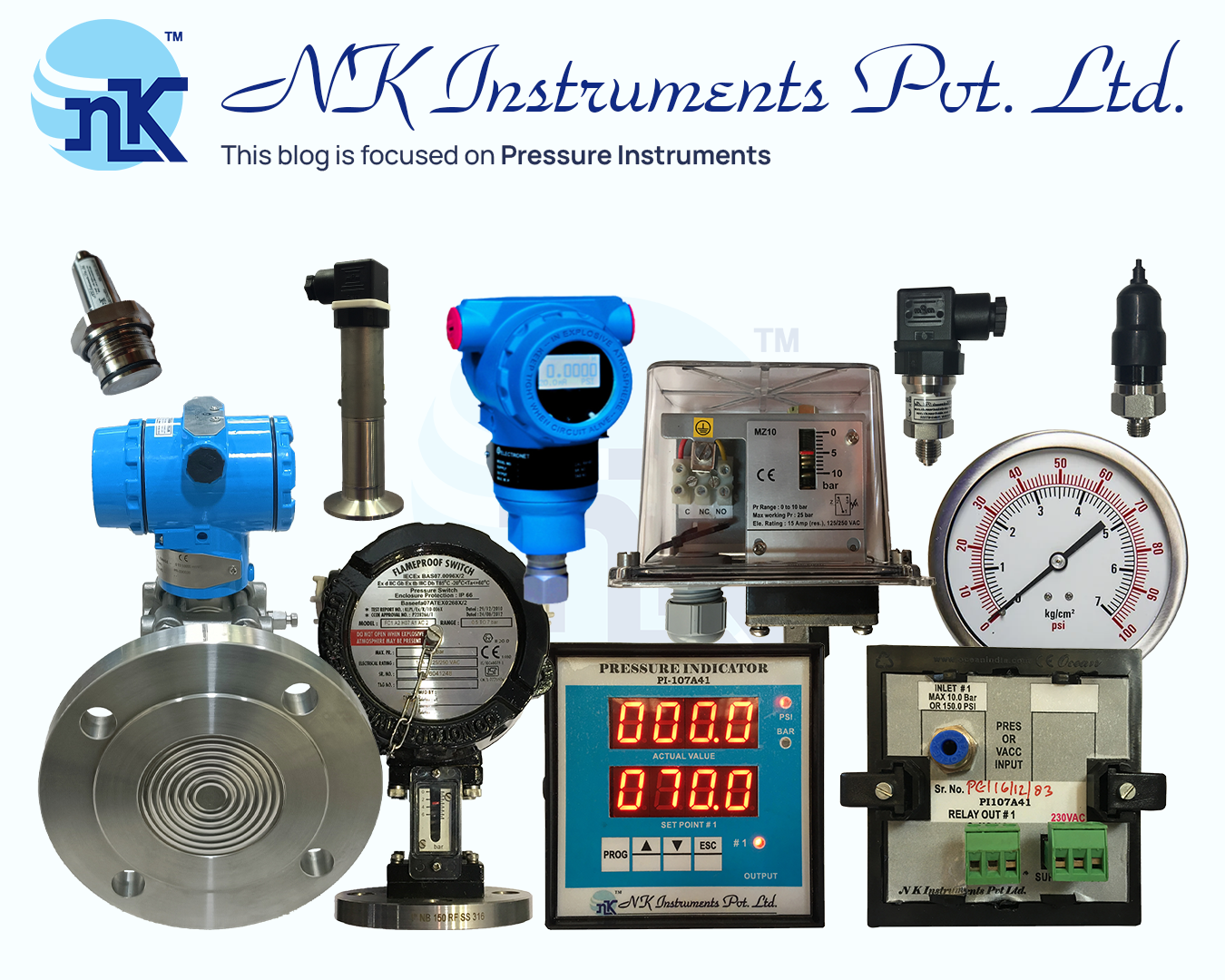
Industrial Pressure Instruments: Applications, Types & Selection Guide
In almost every industry—from power plants and pharmaceuticals to food processing and water treatment—pressure plays a crucial role in ensuring smooth, safe, and efficient operations. Whether it's for basic pressure monitoring, interlocking for safety, or precise control in sensitive applications, pressure instruments are indispensable.
In this blog, we’ll explore:
Common industrial applications where pressure needs to be monitored or controlled
Types of instruments used:
A) Pressure Gauges,
B) Pressure Switches,
C) Pressure Transmitters
Key factors to consider while selecting the right instrument are as given below -
Pressure Monitoring in Industrial Applications:
Monitoring pressure is essential for system diagnostics, performance tracking, and safety assurance.
Some typical applications include:
1) Flue Gas Pressure Monitoring
Ensures proper draft and combustion efficiency in boilers and furnaces.
2) Steam Pressure Indication
Used in steam lines and boilers for process monitoring and maintenance.
3) Gravity Pressure Monitoring
Especially in storage tanks or gravity-fed systems to check pressure at the outlet or bottom.
Instruments used are Pressure Gauges / Indicators and their common types are:
Analog Pressure Gauges – cost-effective and widely used
Digital Pressure Gauges / Indicators – available in: Battery-operated, Externally powered (24VDC / 230VAC)
Selection parameters for Pressure Gauges / Indicator include:
Mounting type (bottom, back, panel)
Enclosure type (weatherproof, flameproof)
Pressure range & max. pressure
Wetted parts material (SS304, SS316, PTFE lined, etc.)
Pressure Control for Interlocking & Safety Applications:
Pressure-based control and interlocking help prevent unsafe conditions and equipment failures.
Common examples:
1) High-Pressure Steam Alarm in Boilers
2) Door Locking in Pressurized Chambers & Sterilizers
3) Low Air Pressure Alarm in Pneumatic Systems
4) High/Low Pressure Alarms in Water Hydrants & Water Purification Systems
5) Low Hydraulic Pressure Alarms in Power Packs
Instruments Used are Pressure Switches and the few types in Pressure Switches are:
With Fixed On-Off Differential
With Adjustable On-Off Differential
Dual SPDT Micro Switches
With Flush or Remote Diaphragm Seal
Flameproof / ATEX Certified
Selection parameters for Pressure Switches include:
Settable range
Maximum operating pressure
Wetted part materials
Type of sensing element (piston, diaphragm)
With or without scale
Type of enclosure (IP65, IP67, Flameproof)
Precise Pressure Control in Critical Applications
Some applications require accurate and real-time control of pressure, especially in laboratory, pharmaceutical, and analytical systems:
1) Pressure Chambers
2) Analytical Instruments & Gas Analyzers
Instruments Used are Pressure Transmitters & few types in Pressure Transmitters are:
Compact (Blind) Type Pressure Transmitters
Digital Indicating Transmitters
Flameproof Transmitters
Selection parameters for Pressure Transmitters include:
Output type (4–20mA, 0–10V, mV)
Pressure range and max pressure
Enclosure (Weatherproof / Flameproof / SS Body)
Electrical connection type
Process fitting type
CONCLUSION
Choosing the right industrial pressure instrument depends not only on the application but also on:
Measurement or control needs
Safety requirements
Environmental conditions
Type of media (air, water, steam, gas, oil, chemicals, Viscous or, free flowing media etc.)
From Pressure Gauges for simple monitoring, to Pressure Switches for interlocks, and Transmitters for advanced automation—each plays a unique role in your industrial process.